
We back the people who break the paradigm they built.
Silicon Valley Pioneer Capital invests at the earliest stage in AI and deep-tech companies founded by the world's leading scientists and systems architects.
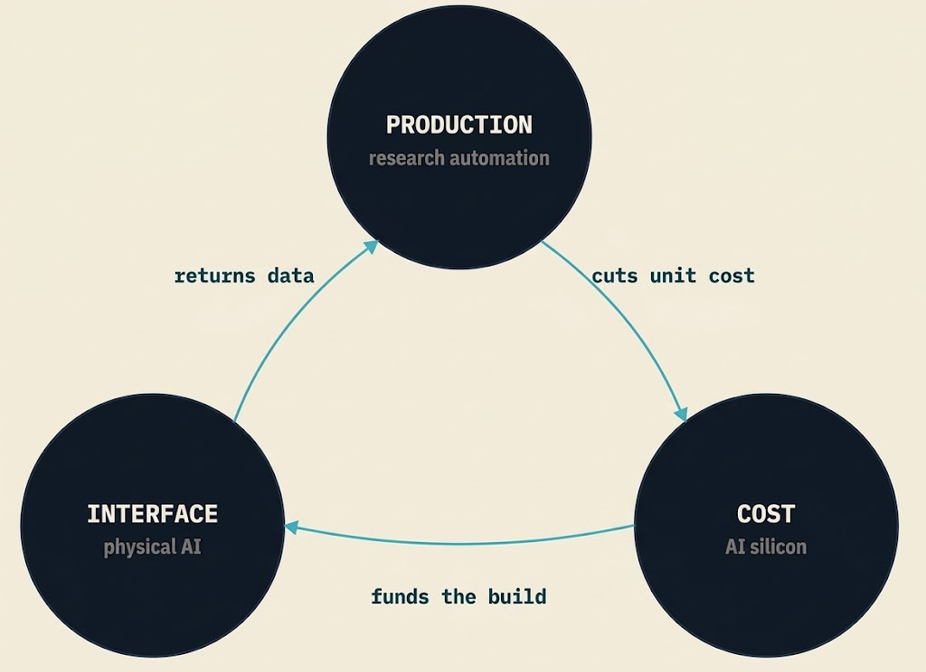
Three curves, and the loop among them
We do not chase incremental gains along the consensus path. We concentrate on three curves — the cost of intelligence, its interface to the physical world, and the rate at which it is produced — and back the reconstruction of each paradigm by the people who built it in the first place.
Cost curve
Cheap compute at the physical limit
Cuts unit compute cost — which is what makes large-scale automation economically sustainable rather than merely possible.
Interface curve
Intelligence acting on the physical world
Converts intelligence into real-world output, and returns new high-value interaction data that exists nowhere else.
Production curve
Intelligence producing intelligence
Pushes the rate of progress toward its limit — and is, by some distance, the most expensive buyer of compute.
From signal to position
A systematic, research-led process for identifying the right companies at the earliest point of formation — and for concentrating capital once the technical risk has actually been retired.
Information flow
Thesis-driven sourcing
A quarterly-refreshed map of frontier technology and architecture trends, sourced from a written thesis rather than from inbound. The target is to identify a paradigm shift six to eighteen months ahead of market consensus.
Talent flow
A standing founder radar
Continuous coverage across Stanford, Berkeley, MIT and CMU, and across the frontier labs. We talk to researchers before they announce a company — a map maintained on a schedule, not assembled when a deal appears.
Capital flow
Discipline, then concentration
A modest initial position buys the alliance and the information seat. Once technical and commercial milestones are validated, an SPV layer concentrates capital into the winners — which is how a fund this size converts access into a return.


Where we meet founders
Before the company has a name
The people who defined the new primitives are leaving the labs that employed them. We track three channels, and aim to be in the conversation before there is a round to be in.
Channel 01
Frontier lab departures
Research leads leaving the large frontier labs — the highest-signal channel we track.
These moves become public as a one-line announcement with no company name, no direction and no round.
By the time a company like that has a name, the allocation is gone.
Channel 02
Academic spinouts
Professors and PhDs with a prior exit behind them — Stanford, UC Berkeley, MIT, CMU, Caltech, UCSD.
Reached through faculty who have already founded and sold a company, and through the students in their groups.
Met while the research works and the company does not exist yet — the point at which a fund our size can still lead.
Channel 03
Systems architects
Silicon and infrastructure people — the scarcest profile we track.
Distributed systems and HPC: taking a model to the limit of the hardware it runs on.
The deepest technical water in the market, and very few people can lead a team into it.

What we underwrite
They left at the top to do something harder
Paradigm creators
People who opened a category rather than optimized inside one. The test is not seniority — it is whether the primitive that the rest of the field now builds on has their name on it.
Theory that ships
Elegant as theory and shippable as engineering. That combination is rare, and it is the one that survives contact with a real production workload rather than a benchmark.
Negating their own work
The strongest signal we know of is a founder walking away from the architecture they are most associated with, because they can see its ceiling before the market can.
Standing at the inflection
Test-time compute, agentic systems and embodied perception all rest on foundations this cohort laid. They are not entering the wave — they built the seabed it is breaking over.
A verifiable record
We separate what a company asserts from what is independently confirmed, and we say which is which — in our diligence, in our reporting, and to our investors. A claim that has not been benchmarked is carried as a claim.
A consistent profile sits behind every position we build. Each of these tests is checked against the public record before a conversation becomes a commitment.


How we work with founders
Operators, not passive capital
Talent
Access to the university and frontier-lab networks that portfolio companies recruit from, at the seniority where a single hire changes the trajectory. Pioneer AI recruits core researchers from frontier AI labs.
Design partner
Commercial networks across the US, Asia and Europe — industrial partners and first customers who can absorb a pre-1.0 product.
Data and compute
Introductions to proprietary data sources and compute capacity, to unblock training before a company has the balance sheet to buy either.
We build trust with founders while they are still inside the labs. After the cheque, the work is the same three things every time — and all three are unblocking, not oversight.
Investment Team


Joanna Wang
Partner · Portfolio strategy & founder support
Leads portfolio companies on early organizational build, compute allocation and proprietary data partnerships. Post-exit founder, with deep familiarity with US technology company formation and cross-border industrialization.
Bin He Maywah
Managing Partner · Fund management & capitalization
Leads fund structuring, compliance, risk and global capital relationships. Two decades operating US private equity and venture funds, formerly managing US$3bn AUM at Cartesian Capital Group. Full-cycle operating and capitalisation experience; co-founder of a Nasdaq-listed company.


Chen Ji Hong
Partner · Asian capital & industry
Wharton MBA; formerly Goldman Sachs Asia investment banking. Now at a leading private equity firm, connecting private banking and industrial capital to funds and deals.
David Shi
Partner · Technology ecosystem & talent
Leads frontier technology trend research and builds the global AI talent map. Works the networks inside the top US research universities and the architect ranks of the large technology companies, to reach teams in the weeks before they incorporate.